The Proof Ladder: A Value Proposition and Proof Machines Can Quote
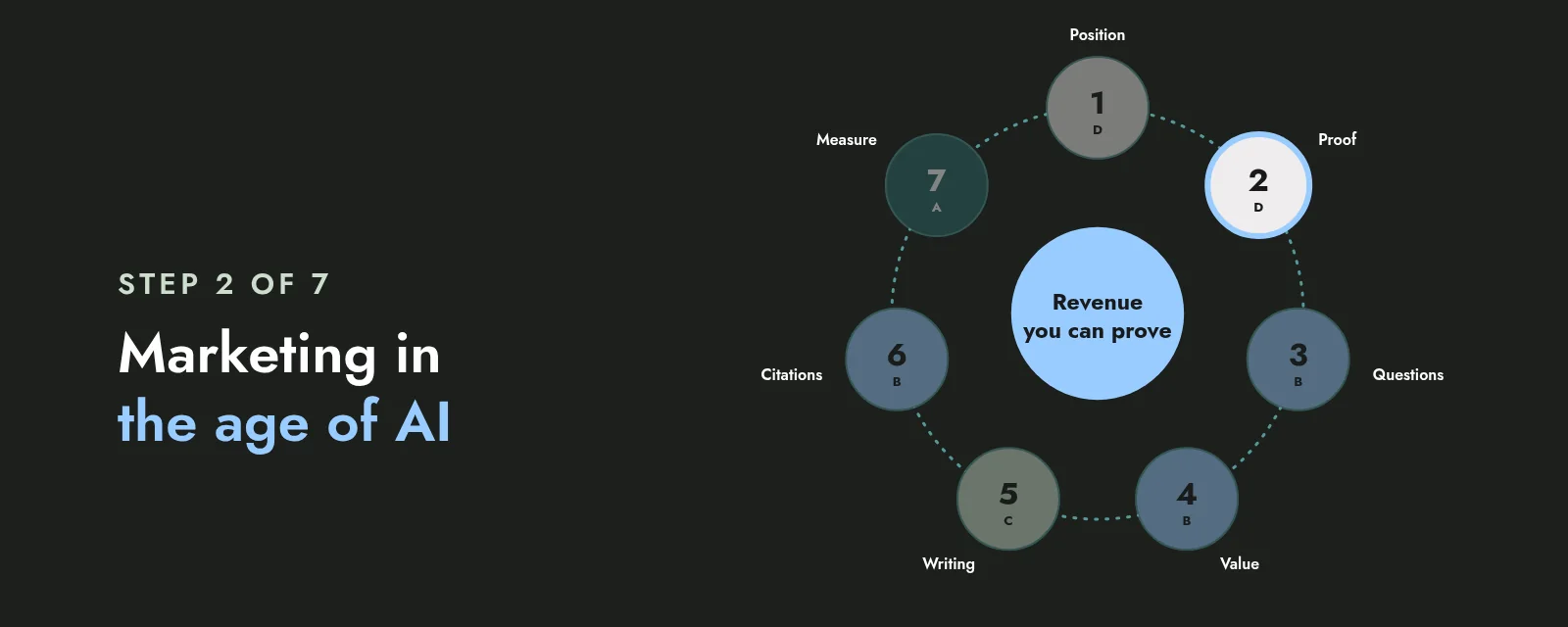
Step 2 of 7 in The Definitive Guide to Marketing in the Age of AI (in Seven Steps). Originally published October 14, 2024. Rewritten for the AI era October 26, 2026.
A value proposition in the age of AI is only as strong as its weakest proof point. Build it as a proof ladder: one value proposition, three supporting reasons, and under each reason a claim that names who, what, how much and when, with a source anyone can check. Adjectives don’t survive an AI summary. Specific, dated proof does.
Why do generic message pillars fail now?
Because they’re exactly what AI writes for everyone. “Quality,” “innovation,” “partnership” and “results” were always weak pillars. In 2026 they’re invisible, because a model can produce them for any company in seconds.
The research shows the cost. Among B2B marketers using AI for content, 58% say quality improved and 12% say it went down. Only 39% see better performance (CMI). More words, no more meaning. As CMI’s Robert Rose put it, for the most part AI “helps marketers type faster, not think better.”
Proof is the one part a model can’t supply for you. That makes it the only premium left.
What is a proof ladder?
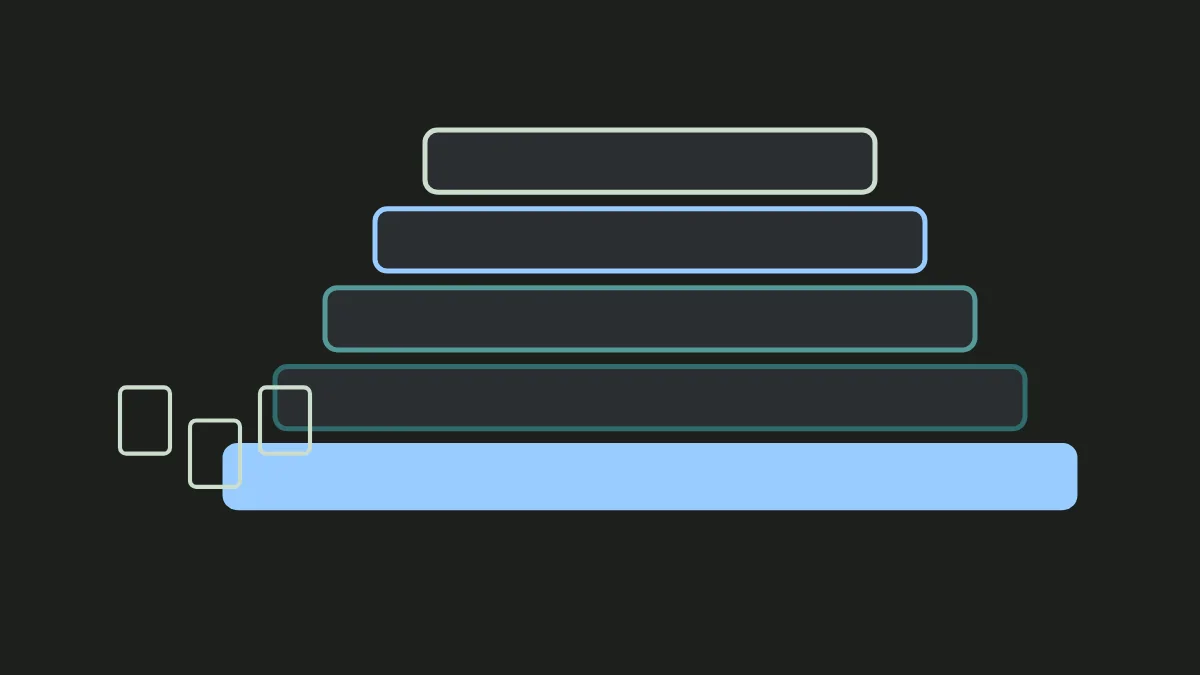
It’s the classic message ladder with the bottom rungs made strict. Each level has one job.
| Rung | Its job | Weak version | Strong version |
|---|---|---|---|
| Value proposition | The one reason to choose you | “We help companies grow.” | “We prove which spend grows revenue, then help you move budget to it.” |
| Reason (pillar) | One of three reasons the proposition is true | “Proven expertise.” | “We use mix modeling and experiments, not last-click reports.” |
| Proof | Evidence for the reason | “Clients love our results.” | A named result with a number, a scope and a date |
| Source | Where a buyer can check it | None | A case study, award listing, press article or customer quote with permission |
| Date | When it happened | None | A year or range, so nobody mistakes old work for new |
The examples in the table are illustrations. The structure is the point.
What counts as proof now?
Proof comes in five strengths. Rank yours, and lead with the strongest.
- Adjectives (“best-in-class”). Not proof. Cut them.
- Self-reported claims with no number (“we reduce costs”). Weak. AI often drops them.
- Named examples (“we worked with a national retailer”). Better, but unverifiable.
- Numbers with scope and date (“revenue doubled at D Custom from 2014 to 2024”). Strong. Quotable.
- Third-party verification (an award listing, a press article, a customer quote used with permission). Strongest, because someone else is vouching for you.
Here’s a level-five example from my own work. Texas Heritage for Living, a publication D Custom produced, won Content Marketing Awards from the Content Marketing Institute in 2017, 2020 and 2023. Anyone can look that up on the awards listings. That’s the kind of proof AI can cite and a buyer can verify in a minute.
How do you write a claim a machine can quote?
Write each claim so it stands alone in one sentence. Five rules do most of the work:
- One claim per sentence. Two claims in one sentence get blended or dropped.
- Name the entity. “Dell,” not “a major tech company.”
- Give the number its unit and scope. Revenue for whom? Savings per year, or total? One site, or all of them?
- Date it. A year or a range.
- Say whose result it was. Credit partners. Never take a client’s revenue as your own.
| Before | After |
|---|---|
| “Drove billions in growth for a leading PC brand.” | “At RAPP (1991–2005), the consumer programs I led generated over $1.5 billion in annual revenue for Dell.” |
| “Award-winning content.” | “D Custom’s client work earned more than 60 national awards while I was president, from 2014 to 2024.” |
The “after” column is longer, but every word carries a fact. That’s what survives compression into an AI answer.
Why should you keep a proof bank?
Because proof rots. Titles change, numbers get rounded differently in every deck, and someone eventually writes “billions” where the record says “over $1.5 billion.” A proof bank stops that.
A proof bank is a living record with five columns: the claim, its source, the approved wording, who approved it and when, and every page where it’s used. I keep one for this site, and I checked every result in this guide against it before publishing. When a fact changes, the bank shows every page that needs updating.
Checklist: build your proof ladder
- One value proposition, in one sentence a buyer could repeat
- Three reasons, each a claim a competitor couldn’t copy
- At least two proof points per reason, ranked by the five levels above
- Every proof point has a number with scope, a date and a source
- Partners credited; client revenue described as the client’s
- A proof bank with approved wording, owner and every page where each claim is used
Where to go next
Once you know what you can prove, plan where to say it. Chapter 3, the question map, turns your proof into a plan built on the questions buyers and their agents actually ask. If you want help building the ladder and the proof bank with your team, talk to me about advisory support: work with me.
Anyone can claim. Only you can prove it, and only if you wrote it down.