Stop Asking AI for a Draft. Staff It Like a Content Team.
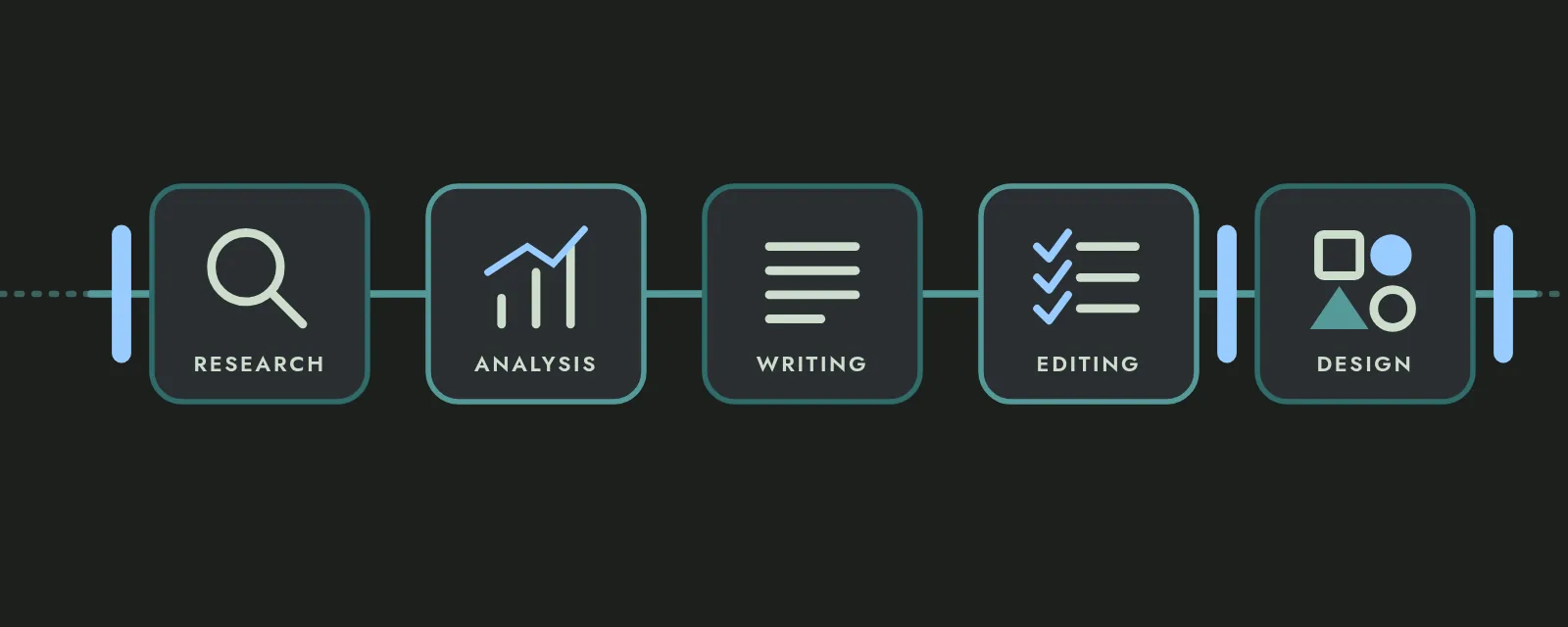
The best B2B content doesn’t come from asking an AI for a draft. It comes from prompting an AI assistant to work as a team of specialists (a researcher, a business analyst, a writer, an editor and a designer), each doing one job and handing its work to the next. One prompt gets you fluent copy. Five roles get you something you can defend in front of a buyer.
I’ve spent 35 years in marketing. Here’s why the team approach works, what it costs, where it breaks, and a framework you can use on your next piece. And this article was produced exactly this way. I’ll show you how at the end.
Why isn’t a one-shot AI draft good enough for B2B?
Because it optimizes the wrong thing. A single prompt (“write 1,500 words on X for CMOs”) asks the model to do five jobs at once: find the evidence, decide the argument, write, cut and check. Those jobs pull against each other. Writing rewards confidence. Checking rewards doubt.
The data matches what most of us feel. In the Content Marketing Institute’s 2026 B2B research, 89% of B2B marketers use AI tools to create written content, and 87% of them say productivity has improved. Only 39% say content performance has improved, and 12% say quality got worse (CMI). CMI’s summary: AI “helps marketers type faster, not think better.”
Typing was never the bottleneck. Thinking was.
What changed in the economics of content?
Start from first principles. A piece of thought leadership is worth the insight it carries, times its credibility, times how many of the right people see it, minus what it cost to make and what it could cost if it’s wrong. AI collapsed one term, the cost of producing words, and left the rest alone or made them worse.
- Words are nearly free. When every competitor can generate fluent copy, fluent copy stops being an advantage.
- Insight and credibility aren’t. In the 2025 Edelman-LinkedIn B2B Thought Leadership Impact Report, 95% of “hidden buyers” (the finance, legal, procurement and operations people who shape deals from outside the meeting) said strong thought leadership makes them more receptive to outreach. They ranked understanding of their business challenges (85%) and domain expertise (74%) well above “the safest choice” (41%) (Edelman).
- Being wrong costs more. Models produce “plausible but false statements,” partly because training and evaluation reward guessing over admitting uncertainty (OpenAI). In October 2025, Deloitte Australia agreed to partially refund a A$440,000 government contract after its report was found to contain a fabricated court quote and citations to papers that don’t exist (AP News).
- Weak output shifts the cost to the reader. In a September 2025 BetterUp Labs and Stanford Social Media Lab survey, 40% of U.S. desk workers said they’d received AI “workslop” in the past month, and each incident took about two hours to clean up (BetterUp Labs).
The marginal cost of a word is close to zero. The marginal cost of a wrong word is not. An AI process built to make drafting cheaper is solving the part of the problem that’s already solved.
Why does splitting the work into roles beat one prompt?
This is proven agency logic. At RAPP (Omnicom Group), where I eventually led more than 80 people across strategy, analytics, creative, media and production, the work on accounts like Dell, AT&T and American Express was split among specialists with clear hand-offs. That’s how agencies make complex work reliable. AI doesn’t repeal that logic. It makes it cheap enough to use on every important piece. Four reasons it works:
1. Each role gets an easier job
Anthropic’s engineering guidance describes “prompt chaining” as trading some speed for accuracy “by making each LLM call an easier task,” and notes that models “generally perform better when each consideration is handled by a separate LLM call” (Anthropic). A researcher whose only job is finding and sourcing facts does it better than a writer who’s also trying to sound smart.
2. Hand-offs make errors visible
In a one-shot draft, a shaky claim is woven into confident prose, and you don’t see it until a reader does. When the researcher must produce a fact table with a URL and date beside every number, a missing source shows up before a sentence is written. Each role saves its output, so you get an audit trail.
3. Review only works against something outside the draft
This is where most people go wrong. Asking the same AI to “check your work” doesn’t reliably help. Researchers at Google DeepMind found that when language models review their own reasoning without outside feedback, accuracy often goes down; earlier gains came from external feedback such as correct answers, tools or people (Huang et al., ICLR 2024). They also found that several model copies debating each other did no better than simple majority voting at the same cost.
So an editor role isn’t valuable because it’s another AI. It’s valuable because it checks the draft against things it didn’t write: the research file, the approved facts and the brief. Self-review isn’t review. Review against a source is.
4. Fresh eyes, even for a machine
Anthropic reported that a lead agent with specialized subagents, each in its own context, outperformed a single agent by 90.2% on its internal research evaluation (Anthropic). That’s a vendor’s internal test on research tasks, so hold it loosely. But it points the same way: a role that starts clean judges the previous work more honestly.
How do you set up an AI content team?
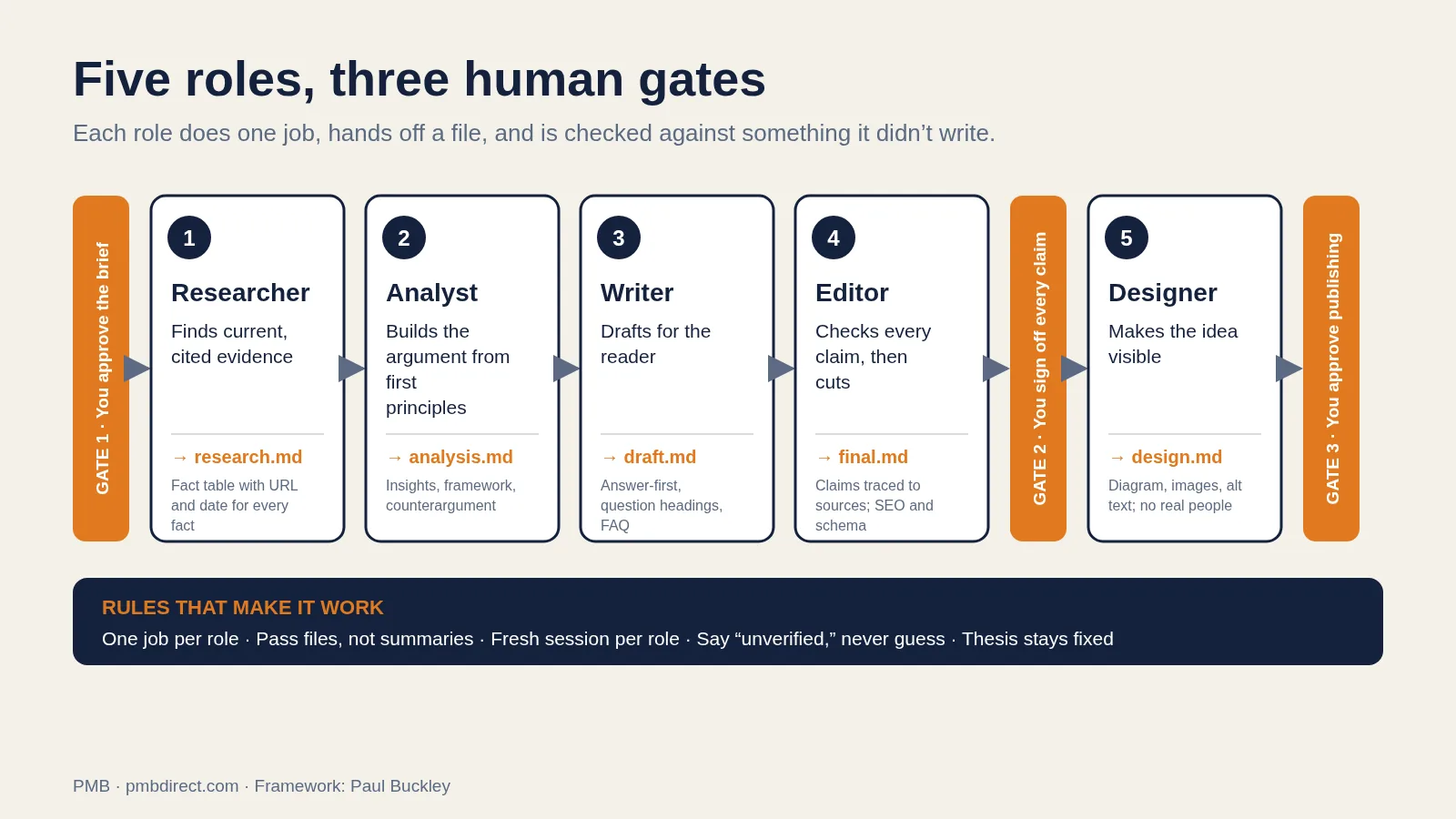
I call the framework five roles, three human gates. I run it in Grok Bot, but the method matters more than the tool.
Gate 1: Approve the brief. Before the AI writes anything, write one page: the reader and the job they’re trying to get done, the single takeaway, your thesis, your real credentials, the action you want, and the claims that will need sign-off. The AI argues your thesis. It doesn’t replace it.
- Researcher. Gathers current, citable evidence and the strongest opposing views. Output: a fact table with a source URL and date for every fact, plus open questions. The key instruction: say “unverified” instead of guessing.
- Business analyst. Turns evidence into an argument from first principles: the reader’s value equation, what changes economically, the best counterargument. Output: an outline, three to five insights, a framework and a map of which fact supports which point.
- Writer. Drafts from the brief, research and analysis, plus your own stories, which only you can supply. Output: an answer-first draft with question-style headings, inline citations, an FAQ and one call to action.
- Editor. Checks accuracy first: every claim must trace to the research or your approved facts, or it gets cut or flagged. Then cuts 15 to 25% and strips the filler. Output: final text, an edit log and the search package (title, description, schema).
Gate 2: Sign off on every claim. Every number, client name and quote.
- Designer. Makes visuals that explain the idea: a framework diagram, pull quotes, a hero image, all with alt text. Never depicts real people.
Gate 3: Approve before anything is published.
Rules that make the difference:
- One job and one output format per role.
- Pass each role the actual files, not your summary of them.
- Start each role fresh (a new session or subagent).
- Tell the editor to check against the research file, not its own sense of what sounds right.
- Keep your thesis fixed from brief to final.
Where do human judgment and experience still matter?
Everywhere that counts. The workflow doesn’t remove the expert. It concentrates the expert’s time where it’s worth the most.
Deciding what to say. In a Harvard and BCG field experiment with 758 consultants, those using AI completed 12.2% more tasks and worked 25.1% faster on tasks within AI’s capabilities. On a task deliberately outside them, AI users were 19 percentage points less likely to get the right answer (Dell’Acqua et al.). Choosing what a market needs to hear is judgment work. That’s the author’s job.
Supplying experience. Google says it rewards content that shows experience, expertise, authoritativeness and trust “however it is produced,” and that using AI “doesn’t give content any special gains” (Google Search Central). The AI wasn’t in the room. You were. At D Custom, where I was president from 2014 to 2024, we doubled revenue and won more than 60 national awards, and none of that came from volume. It came from having something specific to say.
Owning the byline. Google advises against listing AI as an author. Your name goes on it, so your judgment goes into it.
What are the honest limits?
- More machine time. Anthropic says multi-agent systems use about 15 times the tokens of a normal chat and pay off only on valuable tasks. Don’t run five roles for a LinkedIn post. Save it for flagship pieces.
- Slower than one prompt. Plus your review time, which is the point.
- It doesn’t make AI truthful. It makes errors easier to catch. You still have to catch them.
- The evidence is adjacent. I haven’t seen a controlled study of this exact workflow against a single prompt for marketing content. The case rests on research into how AI handles tasks and checks, and on how good content teams have always worked.
- No point of view in, no point of view out. If the brief has nothing to say, five roles will produce a well-organized article that says nothing.
How was this article made?
The way I’ve described. I gave Grok Bot my thesis and background. It ran a brief, then a researcher pass (a sourced fact table, with unverified items flagged), a business analyst pass (argument, counterargument, framework), a writer pass, an editor pass that checked every claim against the research and cut the draft by about a sixth, and a designer pass for the diagram and images. Each role saved its own file. I approved the brief, signed off on every number and client name, and approved the final.
If it reads like the work of someone who has spent 35 years arguing about what’s worth publishing, that’s because the parts that matter were.
Want a content engine your buyers trust? Email hello@pmbdirect.com or call (214) 435-8235. Or follow PMB’s insights for more on what’s working in B2B content.
Related from PMB: AI vs. the human element · The AI-powered future of content marketing