The Definitive Guide to Marketing in the Age of AI (in Seven Steps)
Originally published February 24, 2025 as The Definitive Guide to Content Marketing. Rewritten for the AI era October 26, 2026.
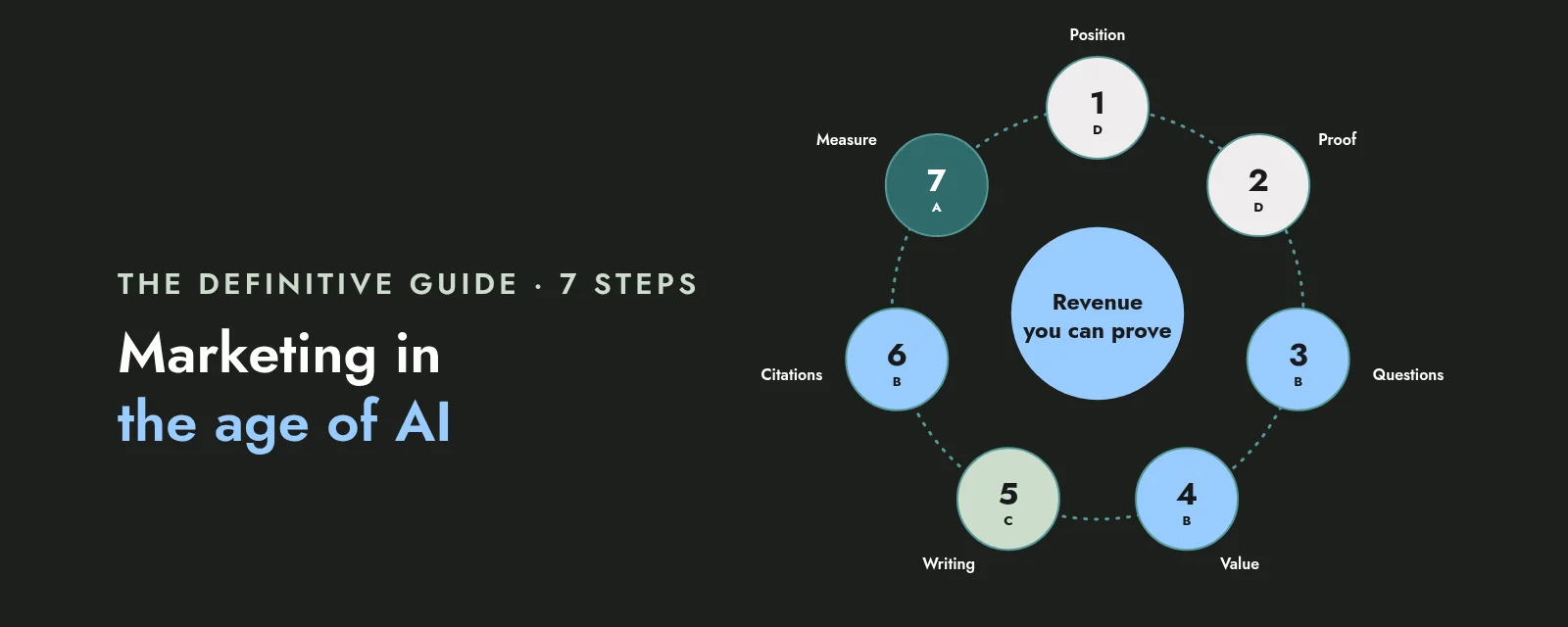
Marketing in the age of AI comes down to seven steps. Own a position others can repeat. Back it with proof a machine can quote. Plan around the questions buyers and their agents ask. Do the buyer’s work. Write for three kinds of reader. Earn citations instead of chasing clicks. Measure what grows revenue when the clicks disappear. Content got cheap. A clear position, checkable proof and honest measurement did not.
I wrote the first version of this guide for buyers who searched, clicked and read your site. Many of them now stop at the AI answer. This is the rewrite.
What changed for marketers when AI started answering first?
Three things changed at once. Buyers ask machines first, machines write most of the first drafts, and the click that held measurement together is disappearing.
Buyers ask machines first. Google says AI Mode passed one billion monthly users within a year of launch (Google). In B2B, 45% of the 645 buyers Gartner surveyed used generative AI in a recent purchase. And 69% prefer to check what the AI told them with a sales rep (Gartner).
Machines write the first draft. In the Content Marketing Institute’s research for 2026, 87% of B2B marketers using AI for content say productivity improved. Only 39% say content performance did (CMI).
The click is disappearing. Pew Research Center tracked 68,879 real Google searches. When an AI summary appeared, people clicked a regular result on 8% of visits. Without one, they clicked on 15% (Pew). Ahrefs found that an AI Overview goes with a 58% lower click-through rate for the top-ranked page (Ahrefs).
Put those together and you get the trap most teams are in: more content, same results.
What are the seven steps of marketing in the age of AI?
The seven steps are the same spine as the original guide, but each one now answers a different question. The table shows what each step used to ask and what it has to ask now.
| Step | The original question | The question now | Chapter |
|---|---|---|---|
| 1. Position | How do we stand apart on our own site? | Will AI and other people repeat our position in one sentence? | Position for the answer |
| 2. Proof | What are our message pillars? | Is every claim specific, sourced, dated and quotable? | The proof ladder |
| 3. Plan | What do we publish each month? | Which buyer and agent questions do we own, one page each? | The question map |
| 4. Value | How do we help buyers on our site? | Does our content do the buyer’s work, and their agent’s? | Do the buyer’s work |
| 5. Write | How do we persuade a human reader? | Does it work for the skimmer, the scanner and the machine? | Write for three readers |
| 6. Distribute | How do we drive traffic? | Where do AI answers get their sources, and are we there? | From traffic to citations |
| 7. Measure | Which headline wins the A/B test? | What grows revenue when there’s no click to count? | Measure what grows revenue |
Which step should a CMO start with?
Start with step 7 if you own a budget, and with step 1 if you own a brand. Most CMOs own both, so read chapter 7 first and chapter 1 second.
Here’s why measurement goes first. Every other step costs money, and AI makes it easy to spend that money on things that are simple to count. If you can’t show what grows revenue, the budget drifts toward whatever reports best. Gartner’s 2026 CMO Spend Survey found budgets flat at 7.8% of company revenue, with 56% of CMOs saying they lack the budget for their strategy (Gartner). There’s no slack for guessing.
| If your problem is… | Start with | Then |
|---|---|---|
| “I can’t prove what our spend is growing.” | Chapter 7 | Chapter 6 |
| “AI answers name our competitors, not us.” | Chapter 6 | Chapter 1 |
| “Our content sounds like everyone else’s.” | Chapter 1 | Chapter 2 |
| “Sales says marketing content doesn’t help close deals.” | Chapter 4 | Chapter 2 |
| “My team uses AI, but output went up and results didn’t.” | Chapter 5 | Chapter 3 |
How do the seven steps fit together?
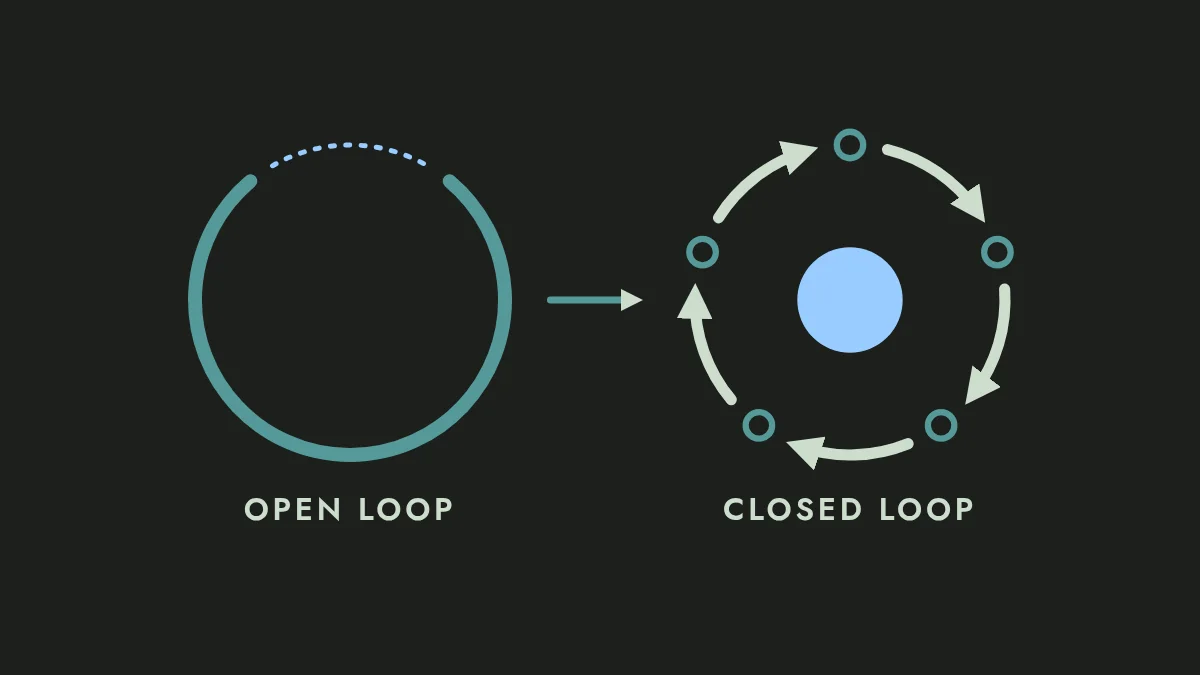
The steps form one loop across four jobs. Steps 1 and 2 build what’s worth saying: position and proof. Steps 3, 4 and 6 get you into the answers buyers and their agents read. Step 5 is how an AI-native team produces the work without losing judgment. Step 7 closes the loop, so the next cycle starts smarter than the last.
Every chapter ends with a scoreboard: how you’ll know the step worked. The old guide saved testing for the last step. This one plans the measurement on page one.
What stays the same?
People still decide on feeling and justify the decision with reasons afterward. They still trust specific stories over vague claims, and they still buy from people who understand their problem. Those ideas carried the original guide, and they carry this one. What changed is who reads first. Now it’s often a machine, and the machine passes along only what’s specific enough to quote.
That’s also why empathy matters more now. When every brand can generate fluent copy, the scarce thing is knowing what your buyer fears and hopes for. I wrote about that in The Power of Empathy and Why We Like Stories.
What doesn’t work anymore?
Three habits from the old playbook now cost you money.
- Publishing for volume. More pages split what little authority you have across near-duplicates. AI engines quote one passage per question. Give each question one owner page.
- Counting traffic as success. Traffic is the wrong scoreboard when the answer appears before the click. The win is being named, cited and chosen.
- Testing small things while the big decision goes unmeasured. A headline test is fine. It won’t tell you whether to move a million dollars from one channel to another. That takes mix modeling and real experiments.
Who wrote this guide, and why trust it?
I’m Paul Buckley. I’ve worked in marketing for 35 years, since 1991, and founded PMB in 2005. Every result below predates generative AI. The skills behind them (a clear position, checkable proof and honest measurement) are the ones AI makes scarce.
- Dell. At RAPP (1991–2005), the consumer programs I led generated over $1.5 billion in annual revenue for Dell.
- Harrah’s. In 2012, working in partnership with Polaris Research, we used marketing mix modeling to cut more than $30 million a year from marketing spend at a single Harrah’s property, with performance maintained.
- D Custom. Where I was president from 2014 to 2024, revenue doubled and client work earned more than 60 national awards.
Disclosure: Paul is EVP, Business Development at Polaris Research, the modeling partner on the Harrah’s work.
I also co-founded Berry Buckley with Drate Berry. More about my background is on About Paul and Selected Work.
Where should you go from here?
Pick the chapter that matches your problem, or read them in order. Each one stands on its own. If you’d rather work through the seven steps with a senior partner beside your team, talk to me about advisory support: work with me.
The teams that win this shift won’t publish the most. They’ll be the ones machines quote and buyers remember.