AI Won’t Replace Your Marketing Team. It Will Expose What Your Team Never Wrote Down.
AI won’t replace a good marketing team, but it will show you exactly where yours depends on memory nobody wrote down. Give a model your brand guide and it writes like everyone else. Give it your decisions, your proof and the reasons behind them, and it starts to sound like you. So the first job of an AI-native marketing team isn’t buying tools. It’s building the memory those tools need.
Why isn’t AI making most marketing teams better?
Because it’s making them faster at the same work.
In the Content Marketing Institute’s research for 2026, 95% of B2B marketers said their organizations use AI apps. Of those, 89% use tools that generate or optimize written content. Among marketers using AI for content, 87% said productivity improved. Only 39% said content performance did. CMI’s Robert Rose summed it up: AI “helps marketers type faster, not think better” (CMI).
Meanwhile the pressure is for more. In HubSpot’s 2026 State of Marketing report, 83.5% of marketers said they’re expected to produce more content (HubSpot).
More content, same results: that’s using a faster engine to drive the old route.
What’s actually holding marketing teams back from scaling AI?
Process and memory, not budget or tools.
Gartner’s 2026 CMO Spend Survey of 401 marketing leaders found CMOs now put 15.3% of their marketing budgets into AI. Seventy percent call becoming an AI leader a critical goal. Yet only 30% report mature AI readiness, and 70% say their internal marketing processes aren’t mature enough to implement and scale AI (Gartner).
Gartner’s Ewan McIntyre named the risk: CMOs “invest in AI tools faster than they build the data foundations, processes, governance and talent required to scale them.”
Here’s the part that rarely gets said. A process is mostly memory: what we decided, why, what we tried, what we’re allowed to claim. In a 2018 Panopto survey of 1,001 U.S. workers, 42% of the knowledge people used in their jobs was unique to them. When they left, their coworkers couldn’t do that 42% of the job (Panopto via PR Newswire). That was before generative AI. Now that knowledge has a second customer: the model that can’t do its job without it.
What does “institutional memory” mean for a marketing team?
It’s the written record of why your marketing is the way it is.
Ask any marketing team why the pricing page says what it says. Someone can find the page in seconds. The reason it was written that way, the deal it was meant to help and what happened to that deal usually left with the person who wrote it.
AI makes that gap expensive. A model asked to write your next campaign will fill every missing fact with the most average answer on the internet. That’s where the “AI sounds like everyone else” problem comes from. It isn’t the model. It’s the missing memory.
How should a marketing team be structured for AI?
Around the memory and the gates, not around the tools.
The useful split isn’t “AI does the writing, people do the strategy.” It’s this: AI does more and more of the production, and people own the decisions and the vouching. Someone has to decide what the piece is for, approve what it claims and put their name on it.
| Work | AI can do most of it | A person owns it |
|---|---|---|
| Research and first drafts | Gathering sources, summarizing, drafting, formatting | Choosing the question worth answering |
| Claims and proof | Checking each claim against the approved list and live sources | Deciding what the company is allowed to say |
| Positioning and voice | Applying the guide consistently, at volume | Writing the guide, and changing it |
| Measurement | Pulling numbers, flagging changes | Deciding what to fund, cut or test |
| Memory | Filing decisions and finding them again | Writing down the why while it’s fresh |
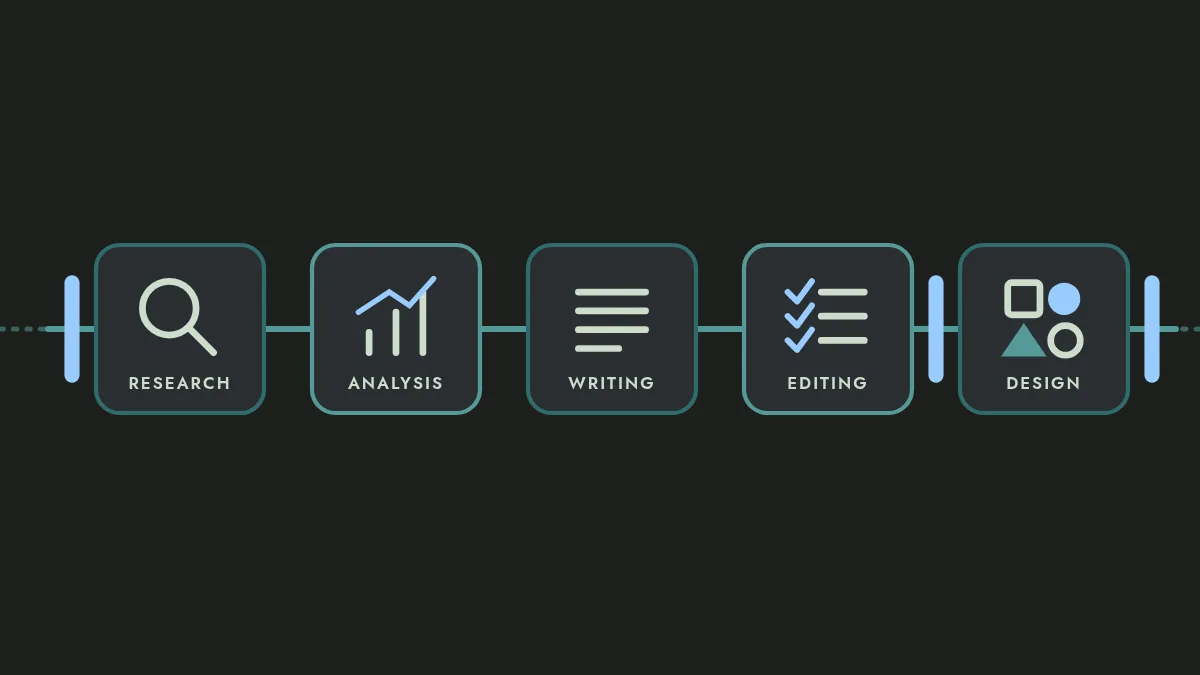
We run our own content this way, and I described the method in Stop Asking AI for a Draft. Staff It Like a Content Team. Each AI role works as a separate pass: research, analysis, writing, editing and design, with a separate fact-check against the sources before anything ships. Every claim about my own work has to match a claims sheet that records its source, who approved it and when. Nothing publishes until I approve it. That sheet is our institutional memory in its simplest form.
For a deeper look at where AI’s work ends and yours begins, see AI vs. The Human Element. For what goes into the memory first, see the message ladder: your value proposition, pillars and proof.
Will AI replace marketing agencies?
It’s changing what clients will pay them for.
In Gartner’s 2025 CMO Spend Survey, 39% of CMOs planned to cut agency budgets, and 22% said generative AI had already reduced their reliance on external agencies for creativity and strategy (Gartner).
The agencies see it. In September 2026, Omnicom’s CFO, Phil Angelastro, told an investor conference that the way Omnicom gets paid “is going to transition” from time toward outcomes. “It’s not likely to happen overnight,” he added. He noted that 80% to 90% of the work at Flywheel Digital, an Omnicom ecommerce business, is already priced on outcomes (AdNews).
When the hours shrink, you stop buying hours. You buy judgment and results. And you can only judge results if your own team remembers what it asked for and why.
What should a CMO do first?
Write down what your team knows before you buy another tool.
- List the ten decisions that shape your marketing. Positioning, target buyers, what you’ll never say, what you fund and why. If the reason isn’t written, write it.
- Build one approved claims list. Every proof point with its source, its approver and its date. It’s the single most useful thing you can give an AI tool.
- Name the gates. Decide who approves the brief, the claims and the final piece. Put people at the gates, not at the keyboard.
- Keep the “what happened next.” After a campaign, record what it did and what you’ll change. That’s the part every team loses.
- Then pick tools that read the memory. A tool that can’t use your record will keep writing average copy, faster.
I have a stake in this argument: I’m Chief Marketing Officer of Nvitis, an institutional memory and context layer. But the steps above don’t need any product. A shared document and a little discipline get you most of the way.
I’ve built and led teams through big shifts before. At RAPP (1991–2005), I led teams of more than 80 people. At D Custom, where I was president from 2014 to 2024, revenue doubled and client work earned more than 60 national awards. The teams that adapted fastest weren’t the ones with the newest tools. They were the ones who knew why they did what they did.
Where do you start?
If your team is using AI to type faster but not to think better, talk to me about building your AI content team. We’ll set up the roles, the gates and the memory that make AI output sound like you and survive a fact check.
Your team’s best thinking is already there. It just isn’t written down yet.